Bitcoin vs. Ethereum: Key Differences and Advantages

Bitcoin and Ethereum are two of the best-known cryptocurrencies, but they play very different roles: Bitcoin as digital gold, Ethereum as a platform for smart contracts and dApps. Learn the key differences and how to buy BTC and ETH on the Bitcoin Store platform.
Table of contents:
Cryptocurrencies have become one of the most interesting areas of modern finance over the past decade. From a niche technology followed only by enthusiasts, they’ve grown into a global phenomenon tracked by both retail investors and large institutions. At the centre of this world are two of the best-known digital assets: Bitcoin (BTC) and Ethereum (ETH).
In this blog, we’ll walk through the key differences between Bitcoin and Ethereum – from their purpose and technology to security and real-world use cases – as well as the advantages they offer to different types of users and investors.
Bitcoin: Digital Gold
Bitcoin is the first cryptocurrency in the world, launched in 2009 by an anonymous creator known under the pseudonym Satoshi Nakamoto. The main goal was to create a decentralised form of money – a system where sending and receiving value doesn’t require banks, governments or any other intermediaries.
Instead of trusting a bank or third party, Bitcoin relies on cryptography, a public blockchain network and thousands of independent computers (nodes) around the world.
Key Features of Bitcoin
Limited supply
The total supply of Bitcoin is permanently capped at 21 million BTC. New bitcoins can only be created up to a certain point, after which no additional coins will enter circulation.
Because of this fixed limit, Bitcoin is considered a deflationary asset, unlike traditional currencies that tend to lose purchasing power over time due to inflation and central bank monetary policy.
Store of value
Thanks to its limited supply and growing demand, many compare Bitcoin to gold in digital form.
It is increasingly used as a long-term store of value, especially in environments where trust in the traditional financial system and fiat currencies is declining.
Security
The Bitcoin network uses Proof of Work (PoW), one of the most battle-tested and secure consensus mechanisms.
Thousands of miners around the world use computing power to secure the network, validate transactions and prevent fraud. Thanks to this model and a high degree of decentralisation, Bitcoin is considered a very secure network for transferring large amounts of value.
Use cases
Today, Bitcoin is primarily used as a store of value and a means of transferring money globally.
People use it for:
- long-term investing (HODLing)
- fast cross-border transfers
- protecting part of their wealth from inflation and monetary instability
Because of these characteristics, many see Bitcoin as the core asset of the crypto market and the natural starting point for anyone entering the world of cryptocurrencies.
Ethereum: The Foundation of Decentralised Applications
Ethereum was launched in 2015 with the idea that blockchain can be much more than just a system for sending and receiving money.
Unlike Bitcoin, which is primarily focused on storing value and transferring funds, Ethereum was designed as a platform for building applications – a kind of decentralised computer where developers can deploy and run their own projects.
At the core of Ethereum are smart contracts and decentralised applications (dApps).
Key Features of Ethereum
Smart contracts
Smart contracts are pieces of code that run on the blockchain when certain conditions are met.
They allow various processes and transactions to be carried out automatically, without intermediaries, for example:
- token swaps
- issuing loans
- managing collateral
- distributing rewards or revenue
Once a smart contract is deployed on the network, it cannot be easily changed, which brings a high level of transparency and security.
Ecosystem: DeFi and NFTs
Ethereum is the heart of DeFi (decentralised finance) – a sector that offers services such as lending, saving, trading and insurance without traditional banks.
On top of that, Ethereum has played a key role in the rise of the NFT market, i.e. non-fungible tokens that represent digital assets such as artwork, collectibles or rights to specific content.
Because of this, Ethereum is often seen as the infrastructure on which a large part of crypto innovation is built.
Unlimited supply and the impact of Proof of Stake
Unlike Bitcoin, which has a fixed upper limit of 21 million coins, Ethereum does not have a strictly capped total supply of ETH.
However, with the transition to Proof of Stake (PoS) and the introduction of mechanisms that burn a portion of transaction fees, inflationary pressure has been reduced. In some periods, the supply of ETH can even become slightly deflationary.
Use case: fuel for blockchain activity
ETH, the native token of the Ethereum network, is used as:
- “fuel” for the network – paying transaction fees and executing smart contracts (so-called gas)
- a medium for running and interacting with decentralised applications
- the base asset for issuing other tokens (e.g. ERC-20, ERC-721)
- collateral in DeFi protocols
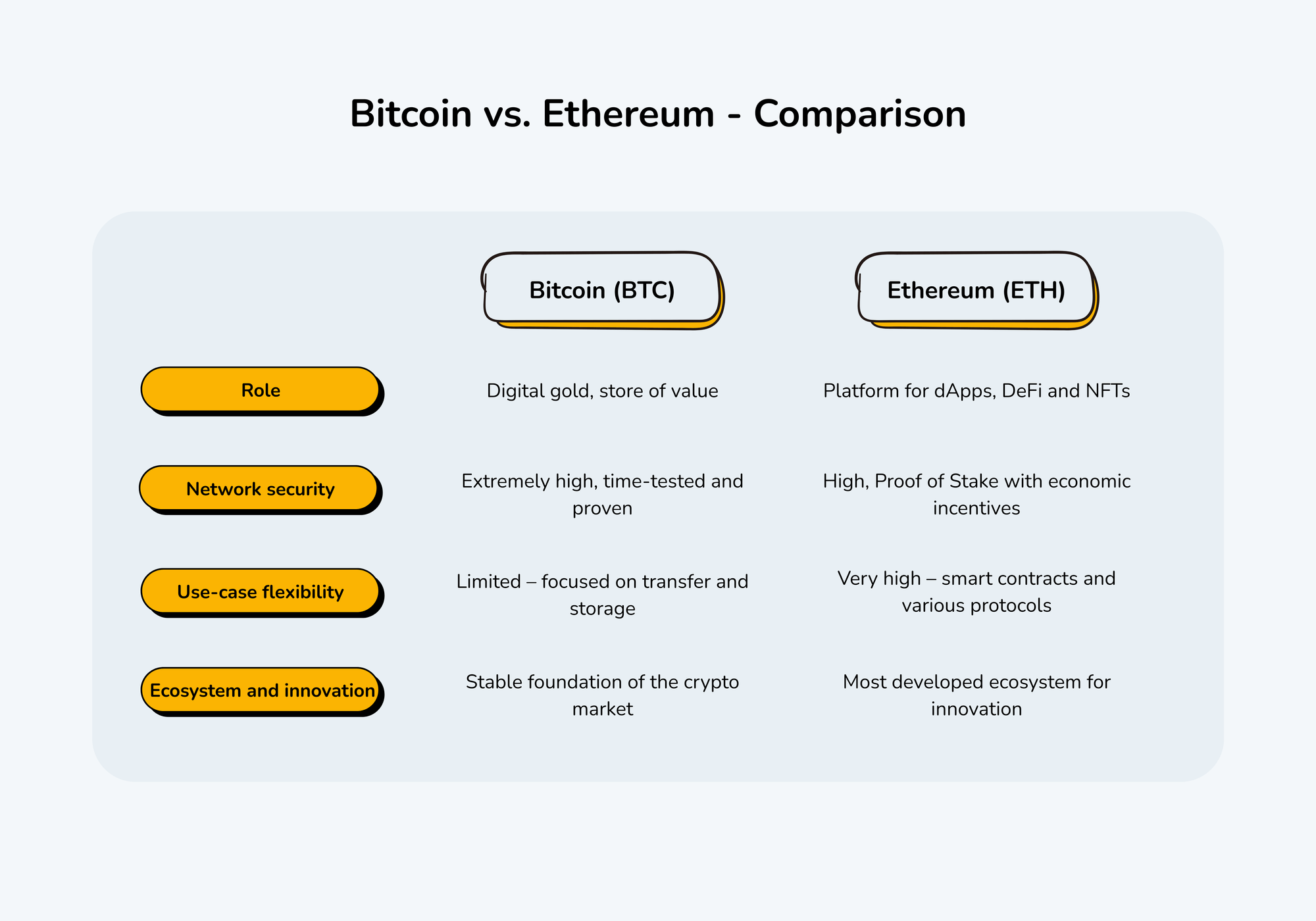
Thanks to these characteristics, Ethereum is often described as a platform for innovation, while Bitcoin is viewed as the primary digital store of value. Together, they form the backbone of today’s crypto ecosystem – but with very different roles.

How to Buy Bitcoin and Ethereum
Buying Bitcoin and Ethereum through the Bitcoin Store platform can be done in just a few simple steps – via the web platform, mobile app or at physical exchange offices.
1. Create an account on Bitcoin Store
Sign up on the Bitcoin Store platform with your email address and password.
Once registered, you’ll get access to your profile and a clear, easy-to-use interface for buying cryptocurrencies.
2. Verify your identity
For higher limits and full access to all services, you’ll need to complete KYC verification (entering basic personal details and submitting an ID document).
This is a standard procedure on regulated crypto platforms and is there to protect clients and prevent misuse.
3. Deposit funds
After your account is approved, you can deposit funds that you’ll use to buy Bitcoin and Ethereum. You can choose from common payment methods, such as: bank transfer, card payment or cash deposit in physical Bitcoin Store branches.
4. Choose Bitcoin or Ethereum
In the list of cryptocurrencies, select Bitcoin (BTC) or Ethereum (ETH).
Then: choose the amount you want to buy, review the transaction summary and fee, confirm the purchase.
Once confirmed, the BTC or ETH you bought will appear in your account balance.
How Do Bitcoin and Ethereum Fit Into Your Portfolio?
Bitcoin and Ethereum are not competitors in the classic sense – they’re not trying to solve the same problem in the same way.
Bitcoin has positioned itself as a leading digital store of value, often compared to digital gold, chosen by users who want to preserve their wealth over the long term outside of the traditional financial system.
Ethereum, on the other hand, is infrastructure for digital innovation. It is the base layer for smart contracts, DeFi protocols, NFT marketplaces and many other projects that expand the use of blockchain technology far beyond simple value transfers.
For investors, it’s crucial to understand the different roles and risk profiles of these two cryptocurrencies.
A combination of both, backed by your own research and a clear understanding of the risks, can form a solid foundation for a balanced and long-term sustainable crypto portfolio.