What Does a Sudden Rise in Oil Prices Mean for Bitcoin?
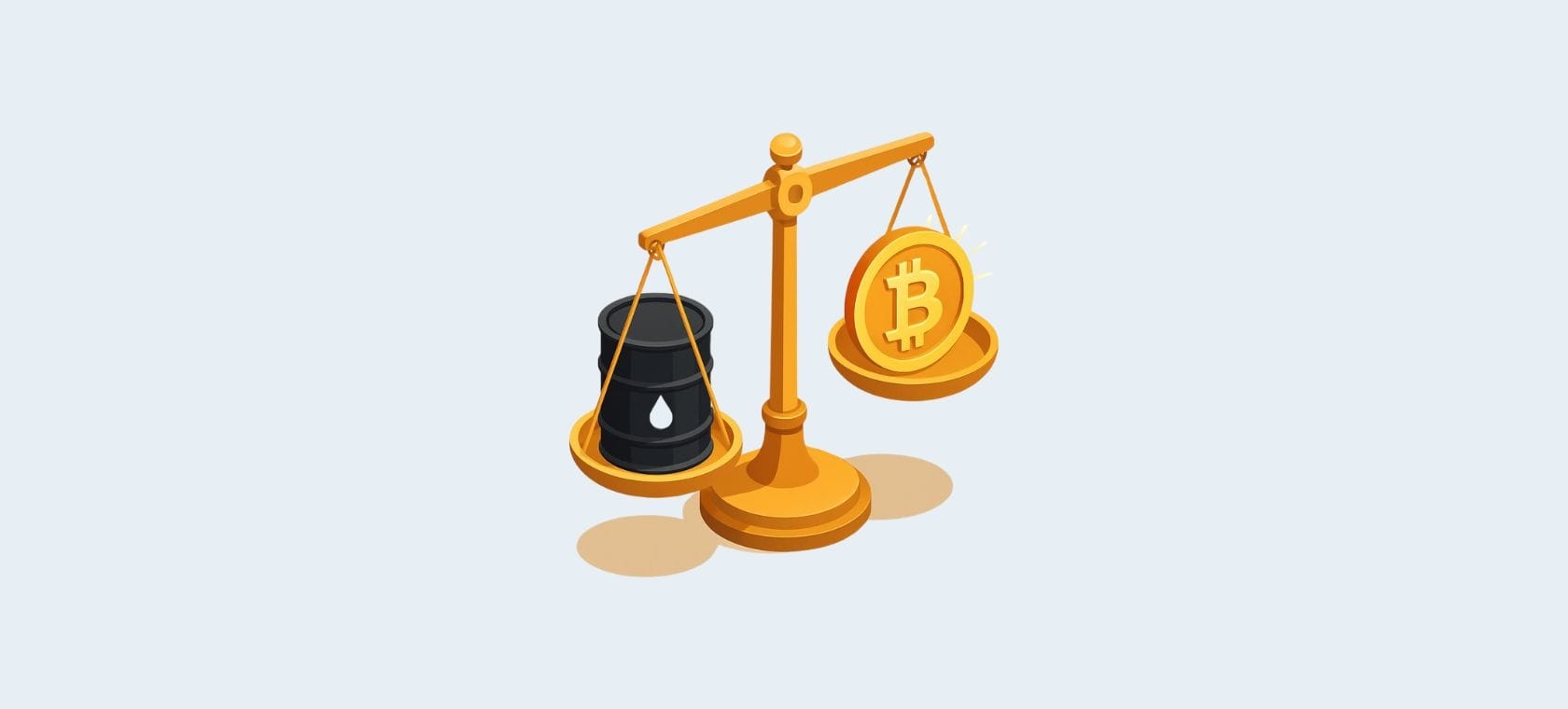
Oil above $100. Inflation is accelerating. Your savings are worth less every day. What is happening to Bitcoin — and why are more and more investors seeing it as the only answer to a crisis they cannot stop?
Table of contents:
- Oil as a Trigger for a Global Inflationary Shock
- Three Scenarios: What if Oil Keeps Rising?
- Why Inflation Inevitably Leads to New Money Printing
- Bitcoin as a Store of Value: Why Its Deflationary Nature Is Key
- Where Is Bitcoin Now and What Does It Tell Us?
- What Does This Mean for Your Wallet?
- 21 Million Reasons to Think
Oil is back above $100 per barrel. Inflation is accelerating. The Fed (Federal Reserve) cannot cut interest rates. And your savings are worth a little less every day.
In times like these, many people ask: what is actually happening to Bitcoin when an energy shock floods the global economy?
The answer is not straightforward, but understanding the mechanism that connects oil, inflation, money printing and Bitcoin could be crucial for every serious financial decision in 2026.
Oil as a Trigger for a Global Inflationary Shock
Oil is not just fuel for cars. It is a fundamental raw material of the modern economy — from transportation and agriculture to plastics and pharmaceuticals.
When the price of oil rises, practically everything else rises with it.
We are seeing this in real time. The military conflict in the Middle East has caused significant disruptions to oil supply through the Strait of Hormuz, which facilitates over $500 billion in oil and gas trade annually.
The result was swift — oil prices rose by around 30% in just a few weeks.
The OECD is already projecting that inflation could reach 4.2% by the end of 2026.
Producer prices (PPI) are growing at more than double the expected rate.
And the Federal Reserve finds itself in an unenviable position: it cannot cut interest rates because inflation is not easing, but it cannot raise them too aggressively either, as that would choke an already slowing economy.
This, in short, is the trap known as stagflation — and it is precisely in this scenario that the relationship between oil, inflation and cryptocurrencies like Bitcoin becomes most interesting.
Three Scenarios: What if Oil Keeps Rising?
Scenario 1: Oil at $120 – Short-term pressure, markets adjust
At $120 per barrel, inflationary pressure is real but still manageable.
Central banks can hold interest rates without being forced to raise them, and the global economy continues to function.
For Bitcoin, this is a zone of increased volatility. Investors become more cautious, capital temporarily withdraws from risk assets, and the Bitcoin price could lose 10–15% of its value.
However, this is not a scenario that changes the bigger picture — it is a correction, not a collapse.
Historically, every time oil has crossed $105, Bitcoin has fallen between 14% and 27% in the short term, but recovered once macroeconomic pressure began to ease.
Scenario 2: Oil at $150 – A serious inflationary shock, the Fed caught in a bind
At $150, the story becomes dramatically different.
Inflation accelerates to levels the Fed cannot ignore, but it cannot aggressively intervene without risking a recession.
In this scenario, Bitcoin behaves like a risk asset in the short term — falling alongside stocks. But something important is building in parallel: more and more investors begin looking for assets that are not subject to monetary policy or government control.
Gold rises, but Bitcoin, as its younger and digital counterpart, attracts growing interest from institutions with a longer horizon than a single quarter.
Bloomberg is already forecasting possible levels of $140 per barrel if the geopolitical situation does not stabilize — and in that case, we can expect a significant repricing across every asset class, including Bitcoin.
Scenario 3: Oil at $200 – A systemic shock and a long-term redefinition of Bitcoin's role
At $200 per barrel, this would not just be an economic shock — it would be a systemic event.
Inflation would explode, the purchasing power of fiat currencies would fall dramatically, and governments would be forced into massive interventions: subsidies, price controls, and inevitably, a new round of money printing.
This is precisely the scenario in which Bitcoin takes on its most important role: a store of value in a world where paper money is losing ground.
In such an environment, the Bitcoin price could become one of the few remaining indicators of stability.
Why Inflation Inevitably Leads to New Money Printing
Here is the mechanism that many people do not understand, yet is crucial for understanding Bitcoin.
When oil is more expensive, everything is more expensive — fuel, food, transportation, utilities.
Companies raise their prices. Workers demand higher wages. Governments spend more on subsidies and social protection. Deficits grow.
And then comes the moment that repeats itself in every serious crisis: the central bank begins printing money to finance government spending and stimulate the economy.
This is not a conspiracy theory — it is standard macroeconomic policy, as we saw in 2008, in 2020, and as is clearly taking shape now.
Every time new money is created, the total money supply in circulation grows — and your savings, expressed in that currency, are worth proportionally less. Not because you lost anything, but because the system has been diluted.
At its most recent meeting, the Fed held interest rates steady at 3.50–3.75% with a notably cautious tone regarding future cuts.
Powell openly acknowledged that the oil shock "will certainly show up" in inflation projections and that the Fed has not made as much progress on inflation as it had hoped. By the end of the press conference, markets had priced out almost all rate cuts for the remainder of 2026.
This means one thing: the cheap money that would fuel growth is not coming anytime soon. But the pressure on governments to keep spending will not go away — and that money has to come from somewhere.
Bitcoin as a Store of Value: Why Its Deflationary Nature Is Key
While billions of new dollars and euros are created every single day, Bitcoin has one fundamental characteristic that makes it different from all other cryptocurrencies and traditional assets: there are only 21 million Bitcoins in existence, and that number will never change.
This is not a marketing claim. It is part of the code that Satoshi Nakamoto embedded into the protocol itself in 2009 — and it cannot be changed without the consensus of the entire network.
No one — not a government, not a central bank, not a corporation — can "print" additional Bitcoins.
Moreover, Bitcoin is a deflationary cryptocurrency.
With the halving that occurs approximately every four years, the reward for miners is cut in half, meaning fewer and fewer new Bitcoins are created over time. The most recent halving took place in 2024, reducing the daily issuance from 900 to 450 new Bitcoins.
Compared to fiat currencies that can be issued without limit, this is a dramatic difference. While inflation progressively erodes the value of paper money, Bitcoin has a built-in protection against that process.
Where Is Bitcoin Now and What Does It Tell Us?
The current Bitcoin price is around $70,000, which is a drop of approximately 20% since the start of 2026. The Fear & Greed Index sits at "extreme fear" levels, having spent most of the past several weeks below 10 out of 100.
On the surface, this sounds bad. But when we look beneath the surface, the picture becomes more interesting.
Despite all the negative sentiment, Bitcoin ETFs have recorded inflows for five consecutive weeks — totalling more than $1.5 billion since the end of February.
Institutional investors — those who go through risk management committees and long-term investment mandates — are buying the dip.
There is another historical pattern that analysts are watching: peaks in oil prices have historically coincided with bottoms in the cryptocurrency market.
October 2018, June 2022, and potentially March/April 2026. If that pattern holds, the current level could be a point of accumulation, not panic.
What Does This Mean for Your Wallet?
A few concrete takeaways:
Short-term: Volatility remains high. Oil above $100, inflationary pressure and uncertainty around interest rates are creating an unstable environment for all risk assets, including Bitcoin. Do not invest money you will need in the next 12 months.
Medium-term: Every time an inflationary cycle peaks and central banks begin cutting interest rates and injecting liquidity into the system, Bitcoin has historically responded with strong growth. Following the COVID crisis, that growth was 900%. The situation is not identical, but the mechanism is.
Long-term: Oil could rise to $150 or even $200. Inflation could remain high for years. Governments will print money to finance their spending. Through all of this, Bitcoin remains the only asset with a mathematically guaranteed limited supply — and that becomes increasingly relevant as the fiat system continues to show its structural weaknesses.
21 Million Reasons to Think
A sudden rise in oil prices is not just a problem for your wallet at the gas pump. It is a trigger that sets off a chain reaction — from inflation and the powerlessness of central banks to inevitable money printing and the erosion of the purchasing power of your savings.
In that context, Bitcoin is not speculation. It is the answer to a question that more and more investors around the world are beginning to ask: how do you protect your savings from a currency that is constantly being diluted?
Oil prices can rise. Inflation can remain high. Governments can keep printing money. But the total number of Bitcoins will remain 21 million — forever.
Disclaimer: Bitcoin Store is not a financial advisory company and is not authorised to offer investment or financial advice. The opinions, analyses and other content on our website are intended for informational purposes only and should not be considered as a basis for making investment decisions. Trading cryptocurrencies involves speculation, and prices can fluctuate rapidly, potentially resulting in the loss of your investment. Before investing in cryptocurrencies, always seek independent advice and make sure you fully understand the risks associated with this type of financial instrument.


