The Halving Cycle: Historical Patterns and the Perfect Entry Point

Bitcoin halving is one of the most studied phenomena in the crypto world. But do you truly understand what past cycles are telling you – and what they are not?
Table of contents:
Every four years, Bitcoin goes through an event deeply embedded in its protocol: halving, the reduction of the reward paid to miners for each new block by half.
This mechanism is no accident. Satoshi Nakamoto designed it to make Bitcoin a deflationary asset with a maximum supply of 21 million.
To date, four halvings have taken place: in 2012, 2016, 2020, and 2024.
Each one left a recognizable mark on the price chart. But is that enough to base an investment decision on?
What does the halving actually change?
When the block reward drops from, say, 6.25 BTC to 3.125 BTC, miners receive fewer new Bitcoins every day.
With stable or growing demand, basic economic logic points toward a price increase. However, markets are complex and the price begins to discount the halving weeks or even months in advance.
The market doesn't wait for the halving, it anticipates it. The real questions are: how much is already priced in, and what comes next?
Historical Patterns Across Cycles
Let's look at the actual data. The table below shows price movements across each halving cycle, from the price level a few weeks before the halving to the all-time high reached in the following 12 to 18 months.

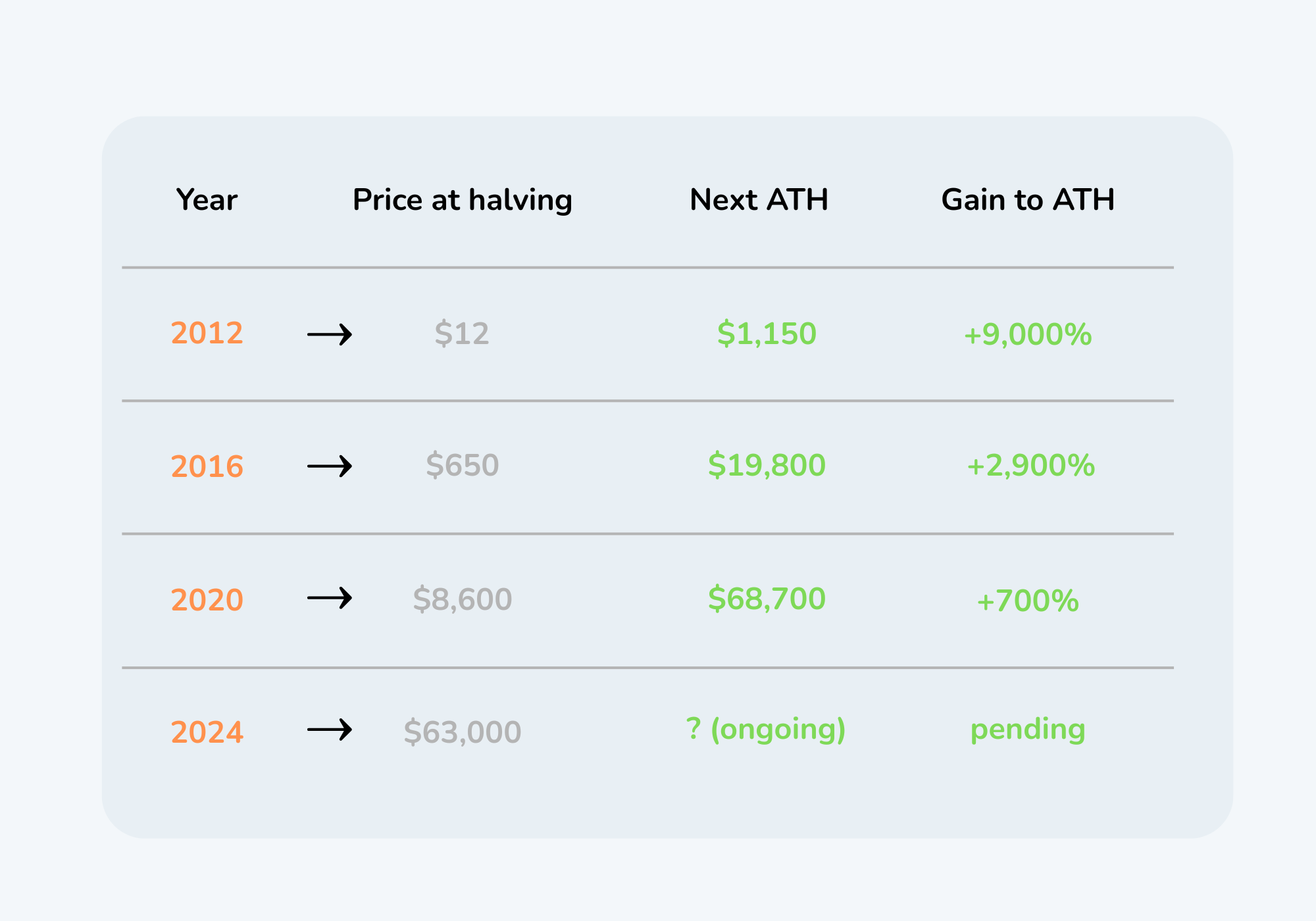
The pattern is clear: each cycle delivers a smaller percentage gain than the previous one. This comes as no surprise. As market capitalization grows, increasingly more new capital is needed to generate the same returns. That said, 700% in a single cycle is still nothing to dismiss.
The Four Phases of a Cycle
Within each halving cycle (roughly four years), analysts identify four distinct phases:
1) Accumulation
Prices are low, media coverage is quiet, and both retail and institutional investors are buying in silence. Lasts 12 to 18 months after the price hits its low point in the previous cycle.
2) Expansion
The halving acts as a catalyst for growth. Prices rise slowly at first, then accelerate. Media coverage picks up. Duration: 6 to 12 months.
3) Euphoria
A parabolic move and a new ATH. Everyone is talking about Bitcoin. Retail investors flood in. A short, intense period. Duration: 3 to 6 months.
4) Correction
A drop of 70 to 80 percent from the peak. Media outlets declare the "end of Bitcoin." The cycle closes, and accumulation begins again.
What Happens to Altcoins?
The Bitcoin halving doesn't only affect BTC. It typically pulls the broader crypto market along with it, though with a delay and varying intensity.
Historically, the pattern repeats in three steps: Bitcoin moves up first, then capital flows into larger altcoins like Ethereum, and toward the end of the euphoria phase even smaller, more speculative projects see extreme gains.
Keep in mind that altcoins can be a double-edged sword: those that gained as much as 100x in 2021 fell 90 to 98 percent during the bear market of 2022. Many projects from previous cycles no longer exist today.
When Is the "Right Time"?
There is no straightforward answer to this question, but history offers some guidance.
Statistically speaking, entering during the accumulation phase has historically delivered the deepest returns at a reasonable level of risk.
Entering just before or right after the halving has also proven rewarding, but at a higher entry price.
The problem is that we only recognize the phases in hindsight. When the price is at its lowest, it is difficult to tell whether that is the bottom of the accumulation phase or merely the midpoint of a broader decline.
This is precisely why many long-term investors rely on a DCA (dollar-cost averaging) strategy, making regular purchases over an extended period of time, which reduces the risk of poor timing.
Important disclaimer: Past patterns do not guarantee future results. Each cycle has unfolded in a different macroeconomic environment: low interest rates, the COVID crisis, regulatory shifts. Cryptocurrencies remain a highly volatile asset class with the risk of losing your entire investment.
When All Is Said and Done
The halving is a fascinating economic experiment unfolding before our eyes.
Historical patterns suggest there is a logic to Bitcoin's cyclical nature, but that logic is never quite the same twice. Market institutionalization, ETFs, regulatory frameworks, and macroeconomics are increasingly shaping dynamics that Satoshi could never have anticipated.
If you are considering entering the market, three questions matter more than perfect timing: what percentage of your portfolio are you willing to risk, can you stomach an 80 percent correction without panic selling, and are you thinking in years or in weeks?
Disclaimer: Bitcoin Store is not a financial advisory firm and is not authorized to offer investment or financial advice. The opinions, analyses, and other content on our website are intended for informational purposes only and should not be considered a basis for making investment decisions. Trading cryptocurrencies involves speculation, and prices can fluctuate rapidly, potentially resulting in the loss of your investment. Before investing in cryptocurrencies, always seek independent advice and make sure you thoroughly understand the risks associated with this type of financial instrument.


